PROPERTY — CÔTE D’AZUR
You’ve landscaped your sloped property in Grasse with a natural terrace held in place by a retaining wall. Everything seemed fine, until the day your neighbor tells you the wall encroaches 15 cm onto their parcel. You checked with a tape measure, looked at the cadastral map on Géoportail, but nothing is clear. What I often find: a 10 to 20 cm discrepancy between the cadastral survey and the actual ground layout, especially on the hillsides of Grasse.
What you see — and what it’s actually hiding
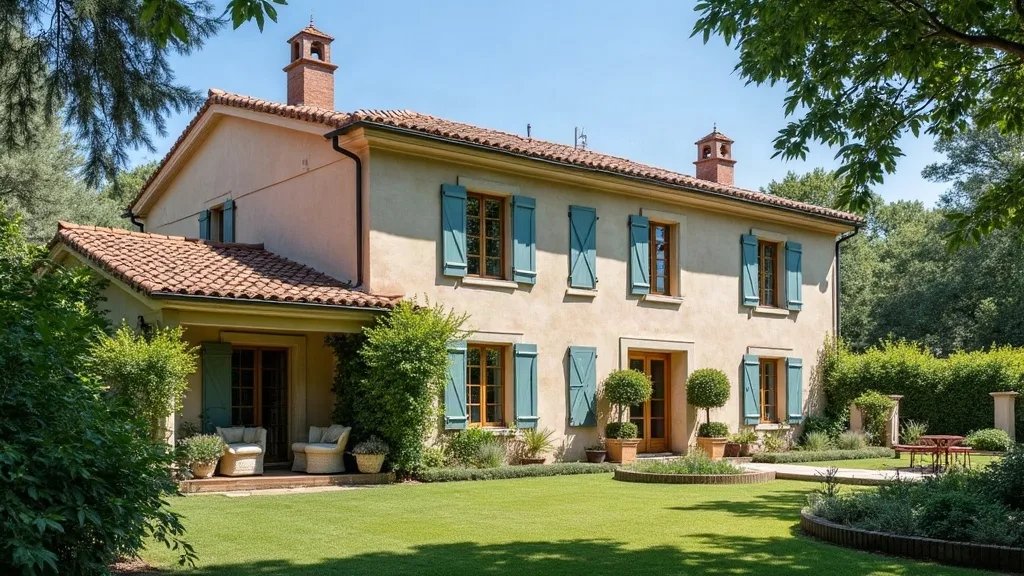
The wall looks well aligned with your property. But your neighbor is waving a cadastral plan and a photo. The problem? Cadastral boundaries aren’t always reliable in hillside areas. It’s not unusual to measure an 18 cm gap between the cadastral record and an actual topographical survey. Slope, settlement of clay soils, and old boundary-marking errors create discrepancies invisible to the naked eye.
What nobody tells you: a retaining wall changes how rainwater drains. In Grasse, with intense Mediterranean rainfall, a 15 cm encroachment can be enough to destabilize the neighboring land. It’s not uncommon to see cases where water seeped under the wall, causing a landslide two years after construction.
The calculations that change everything: earth pressure and stability
To know whether the encroachment is tolerable, you need to calculate the earth pressure on the wall. Under Eurocode 7 (section 9.5.2), the active pressure is: Pa = 0.5 × γ × H² × Ka, with γ = 20 kN/m³ (clay-limestone soil typical of Grasse), H = 2 m (wall height), Ka = 0.33 (active pressure coefficient for drained soil). That gives Pa = 0.5 × 20 × 4 × 0.33 = 13.2 kN per linear meter of wall. Your wall is 8 m long: total load = 105.6 kN. If the encroachment reduces the wall’s usable width by 15 cm, the stress on the soil under the foundation rises from 80 kPa to 95 kPa. The clay soil in Grasse has a bearing capacity of 100 kPa (BRGM data). That’s within the limit, but in seismic zone 3-4 (Alpes-Maritimes), the 0.12 g seismic coefficient increases the pressure by 12%, pushing the stress to 106 kPa. At that point, capacity is exceeded. In practical terms, the wall could become unstable during a moderate earthquake.
What happens if you do nothing
Within 6 months, cracks can appear in the wall, especially after a heavy rainfall event. By year 2, the wall can tilt 2 to 3 cm, worsening the encroachment. The cost of rebuilding a retaining wall in Grasse: between €800 and €1,200 per linear meter, or €6,400 to €9,600 for 8 m — not counting expert and legal fees.
Your neighbor could also sue you for violating Article 545 of the French Civil Code (property rights). The Grasse court often rules in favor of the wronged property owner, ordering the wall demolished at your expense. It’s not uncommon to see a case where a 12 cm encroachment cost €15,000 in restoration work.
Remedies and guarantees: what you can demand
You need a contradictory topographical survey carried out with a land-use planning expert. Eurocode 7 (section 2.4.1) requires a stability check that includes seismic actions. If the encroachment is confirmed, you can negotiate an overhang easement or relocate the wall. Send your neighbor a registered letter with acknowledgment of receipt, then take the matter to the Grasse judicial court if no agreement is reached. A court-appointed expert (like myself) can measure the encroachment with a Leica TS total station, accurate to ±1 cm. Frankly, act quickly: doing nothing will cost you more in the end.
📅 Updated on 08/24/2026 — By Cassini Expertise, independent building expert covering the 06 & 83 departments. Free quote: 04 22 46 06 04.
To go further:
Frequently asked questions
What should I do if a natural terrace encroaches on my neighbor’s property?
If there’s an encroachment, first check the property boundaries with a licensed surveyor. Then start a conversation with your neighbor to reach an amicable agreement, possibly by signing a right-of-way or overhang easement. If no agreement can be reached, take the matter to the judicial court to have the encroachment stopped.
What’s the minimum distance between a retaining wall and the property line?
The minimum distance is generally 2 meters for a wall over 2 meters high, but this depends on Grasse’s local urban planning code (PLU). Check with the town’s planning department for the exact rules. If the rules aren’t respected, the neighbor can demand demolition or compensation.
Who is responsible for maintaining a shared (party) retaining wall?
If the wall is a shared boundary wall, maintenance costs are split between both property owners. If the wall causes damage (such as a landslide), the owner of the land supporting the wall is liable. It’s advisable to check the property deeds and call in an expert if needed.
Cassini Expertise
Expert du bâtiment indépendant — Antibes (06·83·13·40)
📅 Mis à jour le 25/09/2026 — Cassini Expertise, expert bâtiment indépendant (06·83·13·40).