TOPOGRAPHY — SITE PLACEMENT
You receive the as-built survey report. The urban planning expert reports a 47 cm discrepancy from the site plan in the building permit. You thought you had respected the measurements, tape-measuring from the property line. But here’s the thing: on the ground, reality is stubborn. In Nice, slopes and land registry references play tricks.
What you see — and what it’s really hiding
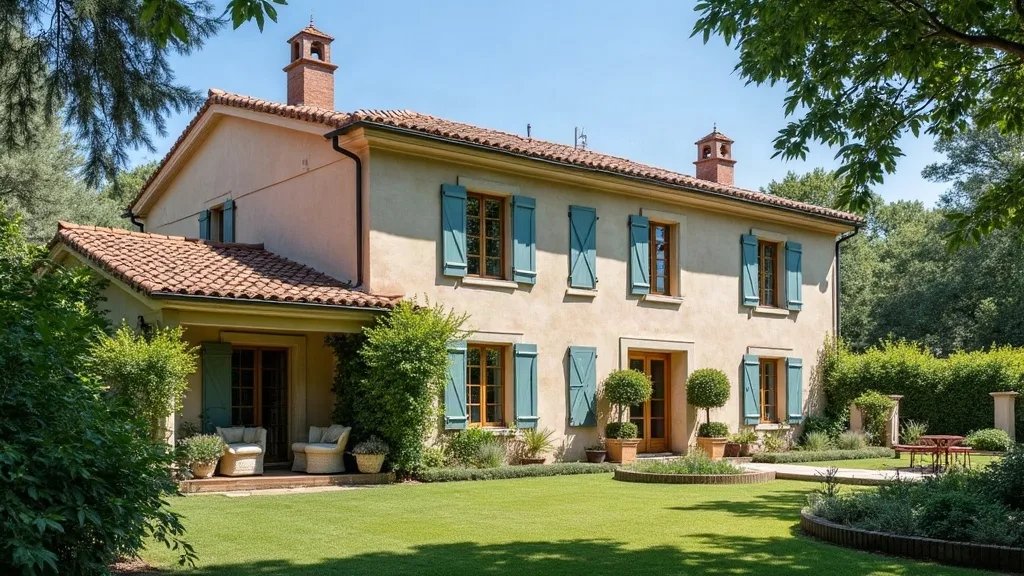
The wall of your extension appears well aligned with the plan. Yet the urban planning expert’s report shows a discrepancy. Why? Because the site plan uses Lambert 93 coordinates and NGF-IGN69 elevations. You, on the other hand, measured from the edge of the road, without accounting for the slope. On a Nice property with a 12% gradient, a 1° angular error produces a 20 cm horizontal offset.
What I often find in this situation: the owner used a consumer-grade laser rangefinder, accuracy ±3 cm, and neglected the slope correction. As a result, the actual placement gradually drifts. The problem isn’t your good faith — it’s the lack of topographic control during construction.
The calculations that change everything: the real discrepancy under the local zoning plan (PLU)
Nice’s Local Urban Plan (PLU) requires placement within a 3-meter band from the boundary. Your site plan shows 2.50 m. The urban planning expert measures 2.03 m — a discrepancy of 0.47 m. Case law generally allows a tolerance of 5 cm for new construction. You are outside that tolerance. Planimetric discrepancy formula: Δ = √((X_actual – X_plan)² + (Y_actual – Y_plan)²). In practice, with RTK GNSS accurate to ±1 cm, measurement uncertainty is negligible. The verdict: a clear non-compliance under Article L462-1 of the Urban Planning Code, paragraph 2, which sanctions any substantial deviation from the building permit.
What this means in practice: the town hall can require demolition or an amendment to the permit. But you may also be able to regularize the situation if the PLU allows it. In Nice, the urban planning department reviews cases individually.
What happens if you do nothing: the risks in Nice
Six months after handover, you receive a letter from the town hall: formal notice to bring the building into compliance. You risk a fine of €1,200 per m² of non-compliant floor area, and a daily penalty of up to €500. After 2 years, the permit can be annulled by the Nice Administrative Court. Cost of proceedings: €5,000 to €15,000.
But there’s worse: if your construction encroaches on a easement (setback) or a non-buildable zone, you could be forced to demolish. A similar case in Nice cost the owner 18 months of proceedings and €22,000 in fees. Don’t let it drag on.
Remedies and guarantees: what you can demand
You are covered by the ten-year structural warranty if the defect renders the structure unfit for its purpose. But here, it’s a placement defect, so the one-year completion warranty applies instead. Procedure: send a registered letter with acknowledgment of receipt to the builder, then file with the Nice Judicial Court. Call on a court-appointed urban planning expert for an adversarial inspection. Article L462-1 of the Urban Planning Code, paragraph 3, allows the mayor to stay the decision if you begin a regularization process. Act quickly: the deadline to challenge the decision is 2 months from the as-built survey.
To go further
📅 Updated on 13/08/2026 — By Cassini Expertise, independent building expert covering the 06 & 83 departments. Free quote: 04 22 46 06 04.
To go further:
Frequently Asked Questions
Non-compliant placement against the site plan: what to do in Nice?
In Nice, if your construction does not comply with the approved site plan, you must regularize the situation by filing an amended building permit application or a prior declaration, depending on the nature of the discrepancies. It’s advisable to check with the town hall’s urban planning department to see whether regularization is possible and to find out the exact procedure.
What penalties apply for non-compliance with the site plan?
In case of non-compliance with the site plan, the Nice town hall can require the work to be brought into compliance, or even impose a fine of up to €15,000 per m² of irregularly built floor area. In serious cases, demolition can be ordered by the Administrative Court.
Can you buy a property with a non-compliant placement in Nice?
Yes, but it carries risks. The buyer must be informed of the non-compliance and can ask the seller to regularize the situation before the sale. Otherwise, the buyer will have to handle the regularization at their own expense, and if that’s not possible, they risk penalties. It’s recommended to consult a lawyer or a surveyor to assess feasibility.
Cassini Expertise
Expert du bâtiment indépendant — Antibes (06·83·13·40)
📅 Mis à jour le 25/09/2026 — Cassini Expertise, expert bâtiment indépendant (06·83·13·40).