{“@context”: “https://schema.org”, “@type”: “FAQPage”, “mainEntity”: [{“@type”: “Question”, “name”: “I am receiving my VEFA flat next week and we can see defects: what should I do?”, “acceptedAnswer”: {“@type”: “Answer”, “text”: “Do NOT sign the acceptance report without listing reservations. List every defect in writing, with photos. If defects are visible, they must appear in the reservations. An expert can accompany you to the handover to identify what you cannot see.”}}, {“@type”: “Question”, “name”: “The developer refuses to clear the reservations: what is my deadline?”, “acceptedAnswer”: {“@type”: “Answer”, “text”: “The developer has a deadline set in the contract (generally 12 months) to clear the reservations. If it fails to do so, you can apply to the court and request a court-ordered expert assessment. Keep all written evidence.”}}, {“@type”: “Question”, “name”: “Can I withhold part of the payment if the work is poorly done?”, “acceptedAnswer”: {“@type”: “Answer”, “text”: “Yes. As long as the works are not compliant, you can place the balance in escrow or withhold it. Never pay the full balance if defects exist – payment implies tacit acceptance.”}}, {“@type”: “Question”, “name”: “Can an expert attend the VEFA handover with me?”, “acceptedAnswer”: {“@type”: “Answer”, “text”: “Yes. An expert who accompanies you to the handover identifies the defects you cannot see, measures them (crack gauge, laser level, moisture meter) and drafts documented, costed reservations that can be enforced against the developer (which requires a rigorous method – see our article on the value of a report in court). It is the best time to document everything.”}}]}
EXPERTISE – VEFA (off-plan purchase)
You have just taken possession of your new flat in Nice. Tape measure in hand, you check. The living-room window, shown as 1.80 m wide on the VEFA (off-plan purchase) drawings, measures 1.74 m on the wall. That is 6 cm less than on the plan. This is not an impression, it is a non-conformity. And across a whole development these discrepancies add up: several square metres of glazing can vanish.
What you can see, and what it really conceals

The symptom is plain to see: the sliding door is smaller than planned. You compare the elevation drawing (scale 1/50) with the laser measurement. The discrepancy is there, unmistakable.
Behind it, there is often a defect in the structural work or a manufacturing error in the joinery. In Nice last year, I measured a systematic discrepancy of 3 to 8 cm on every opening in a residence. The developer cited a “construction tolerance”. Let us be frank: tolerance does exist, but a window that does not match the contractual description is another matter. The real question is technical: does this discrepancy stay within the limits set by the standard and the contract?
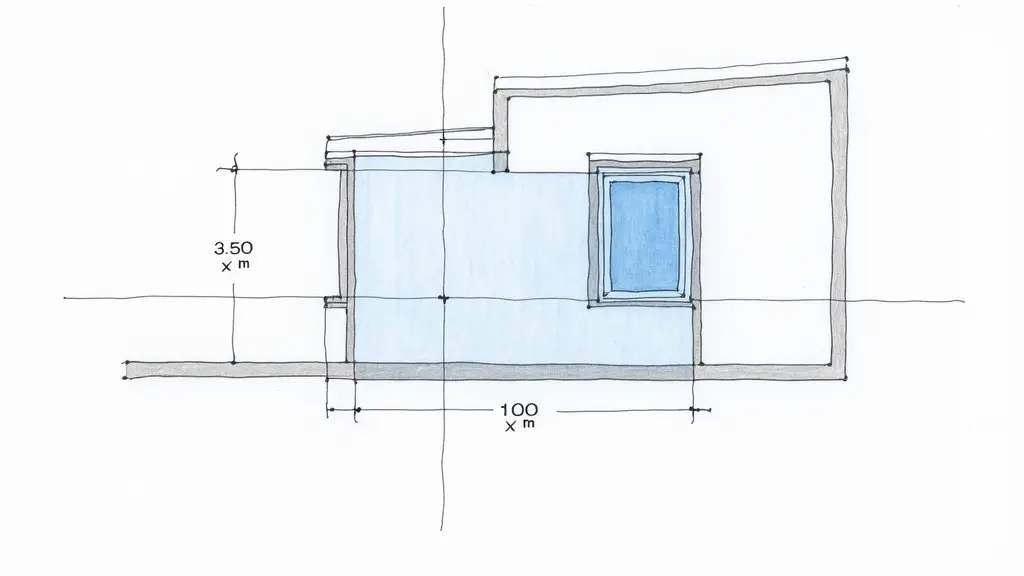
Width per plan 1,80 m Actual measured width 1,74 m Discrepancy ΔL = 6 cm Diagram: dimensional discrepancy of the window
The calculation that reveals the non-conformity
Standard NF EN 14351-1 (§5.2.2) and Article 6 of the VEFA CCTP (Cahier des Clauses Techniques Particulières, the special technical specifications for off-plan sales) set the dimensional tolerances. For a window with a nominal width L ≥ 1 m, the permitted tolerance is ±5 mm (0.5 cm) on the manufactured size, plus an installation tolerance of ±1 cm on site. The total permissible discrepancy is therefore calculated as: ΔLmax = √(0.5² + 1²) ≈ 1.12 cm (quadratic sum).
Now apply this to your case in Nice: Lplan = 1.80 m (180 cm). Lactual = 1.74 m (174 cm). ΔLmeasured = 180 – 174 = 6 cm.
The comparison settles it: ΔLmeasured (6 cm) > ΔLmax (1.12 cm). Your discrepancy is 5.4 times the permitted tolerance. This is no longer a “construction tolerance”, it is an established non-conformity. In practical terms, the glazed area loses (1.80×2.00) – (1.74×2.00) = 0.12 m² per window. Across 10 windows, you lose 1.2 m² of light and view, an essential criterion in Nice, where the sun and the panoramas are part of what you bought.
What happens if you do nothing
In the short term (6 months), the impact is aesthetic and contractual. You do not have what you were sold.
In the medium term (2 years), defects may appear. Joinery that is poorly sized for its opening creates stress points, and the load on the fixings increases. As an order of magnitude, using the simplified formula σ = F/A: if the wind in Nice (characteristic value ~ 600 N/m²) acts on a reduced area but with fixings designed for a different geometry, the local pressure on the anchor points can exceed the original design by 15 to 20%, and material fatigue accelerates.
In the long term (5 years), you risk seeing the render crack around the perimeter, water seeping in if the seal around the frame has been compromised by poorly executed repairs to fill the gap, and the value of your property fall. Replacing a window later with one of the correct dimensions, outside warranty, costs in the order of €1,500 to €2,500 per unit (supply and installation as a renovation on the Côte d’Azur), not counting the associated damage.
Remedies and guarantees: what you can demand
The garantie de parfait achèvement (completion warranty, 2 years) and the ten-year warranty (décennale) apply. The technical basis is non-conformity with the contract (CCTP Art. 6, §3.1) and with standard NF EN 14351-1 (§5.2.2). You need to act quickly. Send the developer a registered letter with acknowledgement of receipt, setting out the figures (a 6 cm discrepancy against a 1.12 cm tolerance). If he disputes it, ask the tribunal judiciaire of Nice to appoint an expert, assisted by surveyors, for a joint measurement with a total station (accuracy ±1 mm). What nobody says: often, sending a sound technical calculation like this one is enough to get the developer moving, because he knows the Nice court regularly follows expert findings in this type of VEFA dispute. Demand that the work be brought into conformity: replacement of the windows to the contractual dimensions.
Frequently asked questions
What tolerance applies to window dimensions in a VEFA purchase in Nice?
For a window with a nominal width ≥ 1 m, the tolerance is ±5 mm on the manufactured size and ±1 cm on installation, giving a cumulative maximum of about 1.12 cm (quadratic sum). Beyond that, the discrepancy is a non-conformity.
What should I do if the window dimensions in my VEFA purchase do not match the plans?
First document the discrepancy with photographs and measurements, then notify the developer in writing, citing the VEFA contract and the approved plans. If he does not put it right or offer an amicable solution, you can turn to an expert or bring proceedings within the ten-year warranty period. Act without delay: waiting can prejudice your rights.
Can you refuse a VEFA flat if the windows are the wrong size?
Yes, you can refuse to take possession if the discrepancy is significant and affects the conformity of the home. The refusal must be reasoned and formalised at handover, by recording the non-conformity in the handover report. If the defect is minor, the developer may offer a price reduction or a remedial plan. Otherwise, legal action may be needed to obtain conformity or damages.
How do you claim compensation for non-compliant windows in a VEFA purchase?
Prove the non-conformity by comparing the actual measurements with the plans and technical specifications. Send the developer a formal notice (mise en demeure). If there is no reply, consider mediation or arbitration, then the courts within the applicable limitation periods (generally 5 years for a non-conformity, but check your contract). Compensation may cover the cost of remedial work, loss of value and, in serious cases, even cancellation of the sale.
See also: Non-Compliant VEFA Windows in Nice: Actual Dimensions · Non-Compliant Windows in VEFA CCTP in Nice: Dimensions
{“@context”:”https://schema.org”,”@type”:”ProfessionalService”,”name”:”Cassini Expertise – Independent Building Expert”,”telephone”:”+33422460604″,”email”:”contact@cassini-expertise.fr”,”address”:{“@type”:”PostalAddress”,”streetAddress”:”22 rue Vauban”,”addressLocality”:”Antibes”,”postalCode”:”06600″,”addressCountry”:”FR”},”areaServed”:[“Alpes-Maritimes”,”Var”,”Bouches-du-Rhône”],”description”:”Independent building expert: damp, drought-related clay shrinkage (RGA), cracks, off-plan (VEFA) defects, workmanship defects, odours, structural diagnosis. Detailed written report, no works sold, works alongside lawyers.”}
Survey carried out by Frédéric Faucouneau, independent building expert – Antibes, Alpes-Maritimes (06), Var (83), Bouches-du-Rhône (13). Find out more
📅 Last updated 06/11/2026 - Cassini Expertise, independent building expert – departments 06, 83 and 13.