EXPERT ASSESSMENT – RESERVATIONS
You have just received the developer’s letter. It confirms that the reservations on your new apartment in Nice. Yet, as you run your hand over the living room wall, you still feel that fine crack snaking across. Or perhaps it’s that water leak under the kitchen sink, reappearing a week after the “repair.” You are not alone: on the French Riviera, nearly 15% of VEFA (off-plan purchase) disputes involve defects declared as corrected… but that persist after the formal clearance. This letter, meant to close the reservation period, becomes the starting point of a new conflict.
What You See – and What It Really Hides

You see a crack reappear. A damp patch that doesn’t dry. A door that still rubs. The developer, on the other hand, sent a technician, perhaps even applied a camouflage coating. The declaration of clearance is administrative. It does not constitute a technical finding of definitive correction. That is where the problem lies.
What we often observe in Nice and its metropolitan area is the confusion between these two steps. Last year, for a client in the Ariane district, a 2 mm crack on a partition wall was hastily filled. Without investigation into its cause – differential soil settlement – it returned in three months, wider. What you observe is often only the symptom. The real question is: was the defect treated at the root, in accordance with accepted building practice, or simply masked to “clear” the file? Only an adversarial inspection, with measurements, can tell.
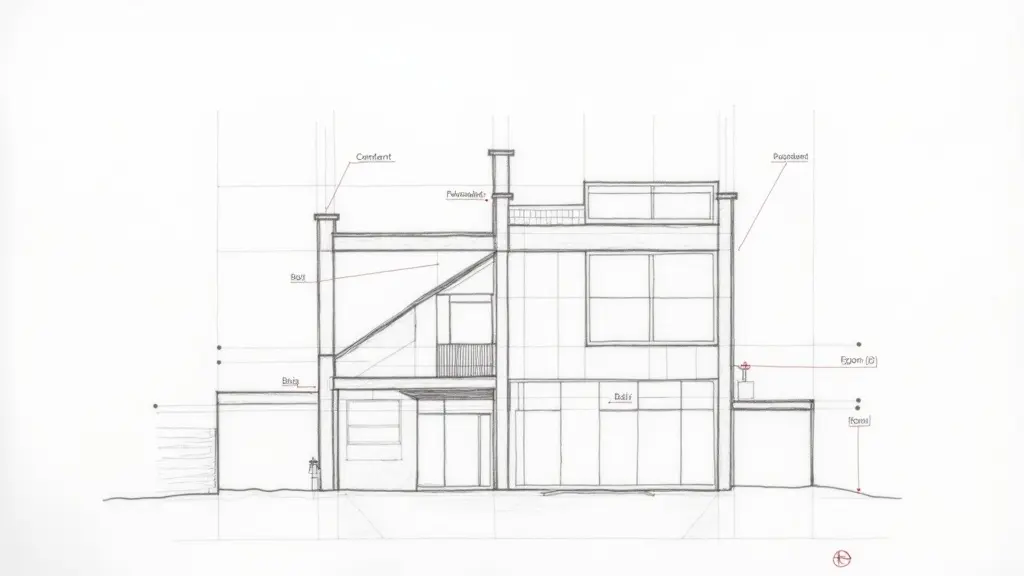
Active crack Camouflage coating Crack corrected at source Length of affected wall: L = 3.60 m Schematic diagram: Surface treatment vs. correction at source A persistent defect after reservations are cleared requires a cross-sectional analysis to identify the real origin.
The Calculation That Reveals the True Extent of the Defect
Let’s take the concrete example of a crack on a floor in Nice. You measure an apparent opening w = 0.5 mm. But is it significant? Standard NF P 11-212 (French standard for geotechnical design) addresses soil-related defects. For a floor, we evaluate the differential deflection. Imagine a reinforced concrete beam (E = 30 GPa, I = 8.33e-5 m⁴ for a 0.20 × 0.25 m section) with span L = 4.00 m, subjected to a permanent load q = 8 kN/m.
The theoretical maximum deflection is f = (5 * q * L⁴) / (384 * E * I). So f = (5 * 8000 * 4⁴) / (384 * 30e9 * 8.33e-5) = 0.0107 m, i.e., 10.7 mm. The tolerance for finished elements is often L/500 = 8 mm. Here, 10.7 mm > 8 mm. The calculation indicates potential non-compliance. If this excessive deflection is the cause of your crack, and it was not corrected upstream (upstream), simple filling is ineffective. What this means concretely: the two-year functioning warranty for items of equipment (Art. 1792-3 of the Civil Code, paragraph 1) may be invoked for this persistent defect, as it affects structural soundness or waterproofing. The calculation shows that the symptom (crack) has a quantifiable structural cause, which remains unresolved.
What Awaits You If You Let It Go
Within 6 months, the 0.5 mm crack can reach 2 mm. Water infiltration, if not treated at its source behind the tile, will generate mould in the lining. In Nice, with the Mediterranean climate and intense rainy episodes, a poorly corrected waterproofing defect on a terrace can lead to water damage for the downstairs neighbour within two seasons.
Secondary problems appear: wood rot, reinforcement corrosion, insulation deterioration. The cost? A superficial repair today: €200 to €500. The same repair, but complete and curative in 2 years, after worsening: €2,000 to €8,000 depending on the extent. Not to mention the loss of property value. We saw a case in Nice where an untreated micro-crack in an expansion joint led, after 5 years, to infiltration requiring complete removal of a curtain wall, billed over €15,000 to a co-owner while the ten-year guarantee was contested.
Recourses and Guarantees: What You Can Demand
The applicable guarantee is the one-year completion warranty (garantie de parfait achèvement) if you are within that period, otherwise the two-year functioning warranty for items of equipment (Art. 1792-3 of the Civil Code) or the ten-year warranty (10 years for defects compromising structural soundness, Art. 1792 of the Civil Code). Your first recourse is a registered letter with acknowledgement of receipt to the developer, stating that the defect persists despite the clearance of reservations and demanding a real intervention within 15 days. Attach photos, videos. If he does not react, have it recorded by a bailiff or an independent expert. Then, refer the matter to the Nice judicial court. This is not a threat; it is the strict application of the Civil Code. Do not let an administrative letter deprive you of your rights.
Frequently asked questions
What should I do if defects appear after reservations have been cleared in Nice?
After reservations have been cleared, if defects appear you must report them to the builder in writing. If the defects fall under the ten-year warranty (art. 1792 of the Civil Code), you can bring proceedings within 10 years of acceptance. Consult a specialist construction lawyer to assess your remedies.
How long does the ten-year warranty last after acceptance?
The ten-year warranty covers damage that compromises the structural soundness of the building or makes it unfit for its purpose. It runs for 10 years from acceptance of the works, even if reservations have been lifted. After that period, any claim is time-barred.
What defects are covered by Article 1792 of the Civil Code?
Article 1792 covers damage affecting the structural soundness of the building (e.g. structural cracks) or making it unfit for its purpose (e.g. water ingress rendering the home uninhabitable). Minor cosmetic defects are generally not covered, unless they make the building unfit for use.
Survey carried out by Frédéric Faucouneau, independent building expert, Antibes, Alpes-Maritimes (06), Var (83), Bouches-du-Rhône (13). Last updated: 23 November 2026. Find out more
Last updated 23 November 2026 - Cassini Expertise, independent building expert, departments 06, 83 and 13.