An amicable expert report is not enough, on its own, to convince a judge. The Cour de cassation (France’s supreme court for civil and commercial matters) has repeated this for ten years, and two recent decisions confirm it. But surrounded by corroborating evidence, or replaced by an agreed expert assessment, the same report carries a very different weight. Here is the rule, the judgments, and the evidential hierarchy that follows.
Our clients in the Alpes-Maritimes, the Var and the Bouches-du-Rhône ask us every week: “Will your report be used in court?” The honest answer fits in one sentence: on its own, no; properly supported, yes. You still need to know what “properly supported” means in legal terms. The Cour de cassation has said so, judgment after judgment.
The rule: an amicable expert report never counts as proof on its own
The principle was laid down solemnly: in a mixed-chamber judgment of 28 September 2012, the Cour de cassation held that a judge cannot base a decision exclusively on a non-adversarial expert report. A report drawn up without the opponent being summoned to take part cannot be the sole foundation of a court decision.
Ten years on, the rule has not moved. In a commercial dispute, Cass. com., 5 October 2022, no. 20-18.709 restates that an amicable expert report cannot count as proof on its own, without a supplementary element. In practice: your report, produced in isolation in support of a summons, will be treated as an indication, never as complete proof.
This caution is nothing personal against party-appointed experts. It stems from the very structure of the amicable report: commissioned and paid for by one party only, drawn up without the opponent being able to attend the measurements, record reservations or produce their own observations. The foundation of every court decision is missing: the adversarial debate.
What the Cour de cassation quashes: lessons from 2021-2022
Appendices do not rescue a private report. Cass. civ. 3e, 21 January 2021, no. 19-16.894: the Court quashed a decision of a court of appeal that had relied on a private report through its appendices, when those appendices had not been put to adversarial discussion. The court expert report, by contrast, is disclosed to the parties and debated: that is precisely the difference.
A private report cannot fix a claim on its own. Cass. civ. 1re, 15 September 2021, no. 20-11.939: an occupation indemnity cannot be fixed on the basis of a private report alone. In the same spirit, Cass. civ. 2e, 9 June 2022, no. 21-12.247 quashes a decision relying on a private report produced alone.
Even a court expert report has its limits. Cass. civ. 2e, 7 September 2017, no. 16-15.531: a court expert report can be relied on against a third party who did not take part in the operations only if it is corroborated by other evidence. Remember the logic: a report’s strength depends less on its author than on the opposing voice it has been given.
What the Court accepts: corroboration and time
All is not lost, far from it. In a case about hidden defects in a vehicle, Cass. civ., 14 September 2022 allowed rescission of the sale on the basis of a technical report drawn up before the purchase, because it was corroborated by a warning light on the dashboard and by the seller’s statements. The lesson applies to buildings: the corroborating element turns a clue into proof. An amicable report backed by a bailiff’s record, letters, invoices or witness statements forms a body of evidence that can persuade the judge.
Another reassuring point: a report’s shelf life. A defect that has not changed in nature keeps its technical value – provided the initial measurements are dated and precise.
The evidential hierarchy, in four steps
The whole evidence strategy of a building dispute fits in this ranking, from weakest to strongest:
- Amicable expert report alone: a clue, never autonomous proof (Cass. com., 5 October 2022, no. 20-18.709).
- Corroborated amicable expert report: report supplemented by a witness statement, a bailiff’s record or a document from the opponent – proof is built from a body of evidence (Cass. civ., 14 September 2022).
- Adversarial expert assessment put to debate: the opponent invited, comments exchanged; the report becomes very hard to set aside.
- Agreed expert assessment: the expert appointed jointly under an agreement concluded between the parties’ lawyers; the report has the same value as an opinion given within a court-ordered investigative measure (Art. 131 to 131-8 CPC).
This fourth step is the most overlooked route in building disputes. Article 131-8 reads:
« À l’issue des opérations, le technicien remet un rapport écrit aux parties. Lorsque la convention ayant pour objet de recourir à un technicien est conclue entre avocats, le rapport réalisé à l’issue des opérations a la même valeur qu’un avis rendu dans le cadre d’une mesure d’instruction judiciairement ordonnée. »
Unofficial translation: “At the end of the operations, the technician hands a written report to the parties. Where the agreement whose purpose is to have recourse to a technician is concluded between lawyers, the report produced at the end of the operations has the same value as an opinion given within a judicially ordered investigative measure.” Read the Code of Civil Procedure on Légifrance (official source; Article 131-8, Book I, Title VI).
We have devoted a full article on agreed expert assessments and a word-for-word reading of Article 131-8.
Our method: a report built for use in court
At Cassini Expertise, every report starts from one premise: it may be used before a judge, a court expert or an insurer. The drafting takes this into account from the first visit. The same standard applies from the first finding of defects in new construction or CCMI contracts.
- Adversarial invitation of the opponent by registered letter: even if they do not come, the trace of the letter proves they could take part;
- Instrumented, dated measurements: moisture meter, crack gauge, thermography, level checks – numerical, reproducible values, not impressions;
- Separate, paginated photo appendices: each shot numbered, dated and called up in the body of the text;
- Standards cited: DTU and norms used for each finding, so that the discussion centres on facts, not method.
We also acknowledge the limit: a report remains a technical document, not autonomous proof. That is why we deliver it with a corroboration file – bailiff’s records, letters, invoices and, for water ingress, the official rainfall data for your town, which we already publish.
Going down with a bailiff when it helps
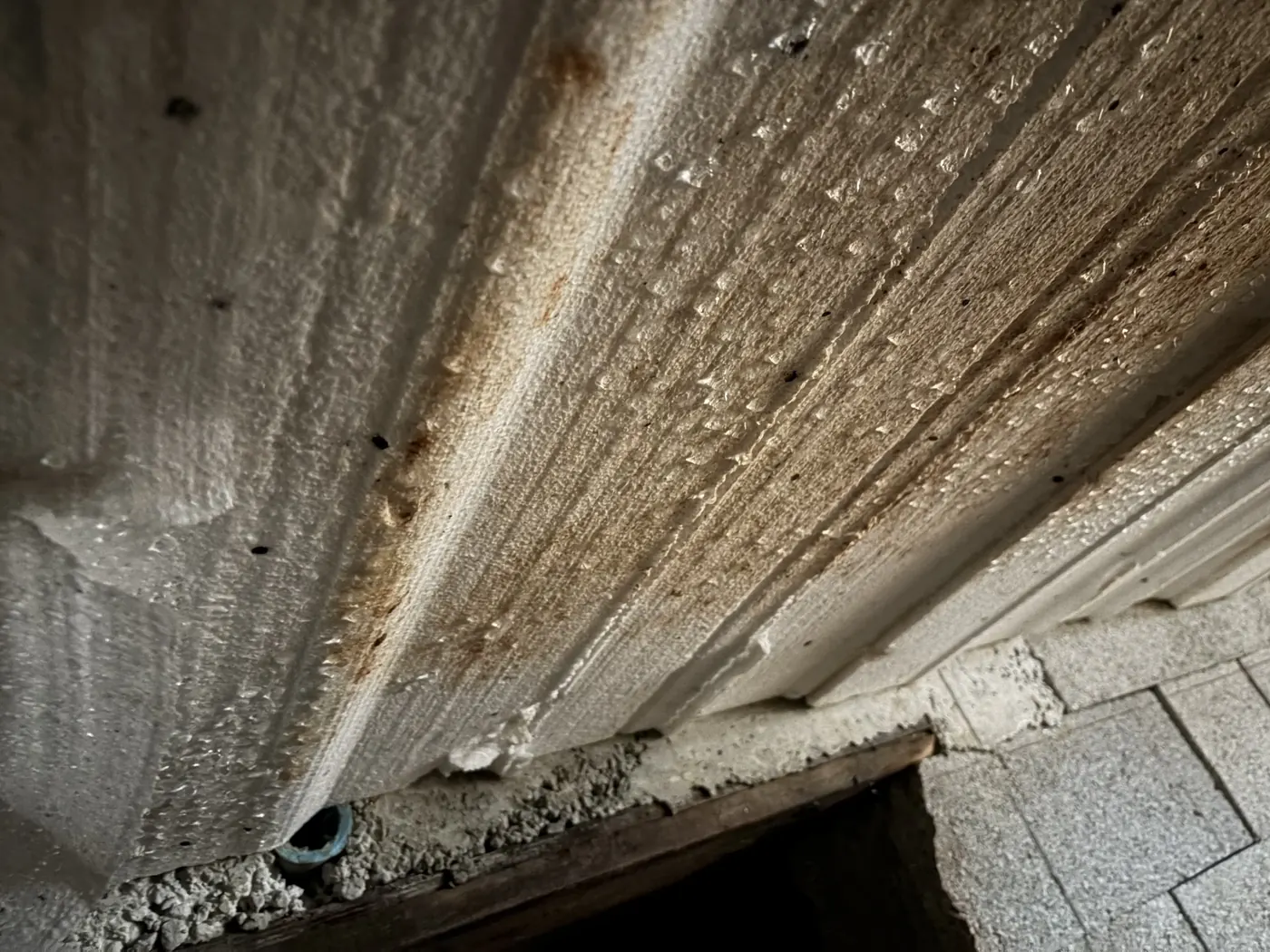
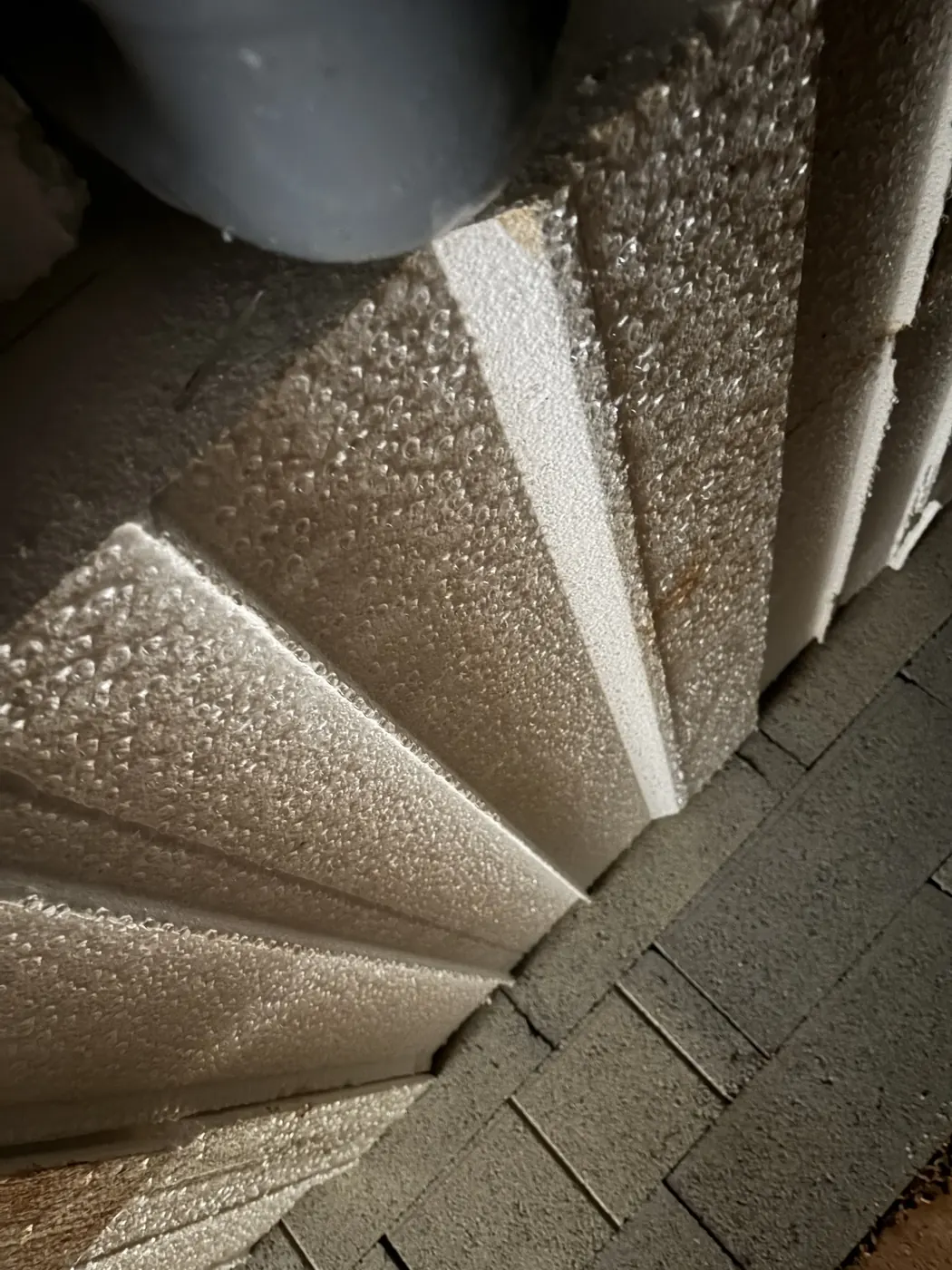
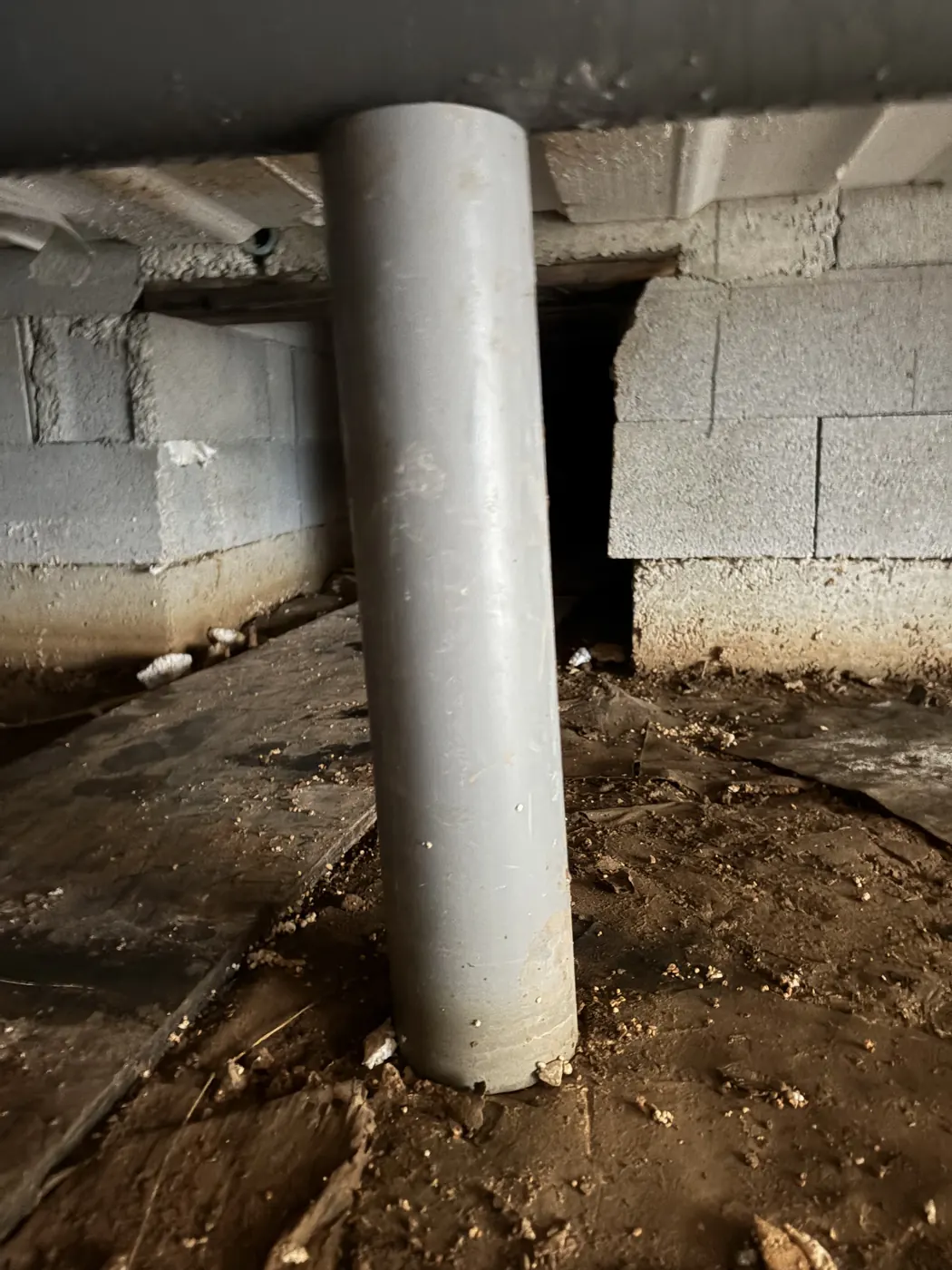
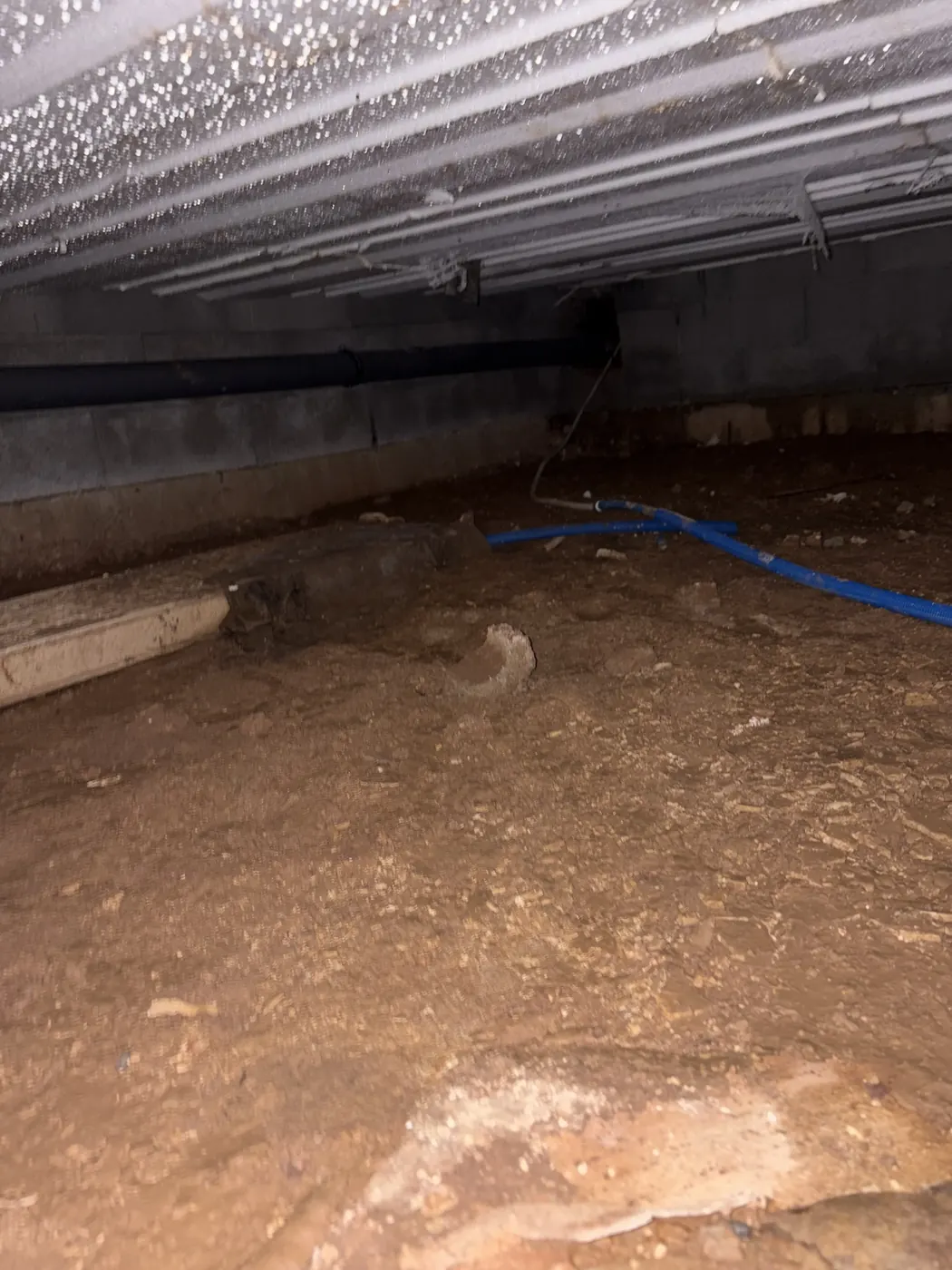
Real photos of a crawl-space descent organised with a bailiff (assignment in the 06 department).
When the cause hides under the floor – damp crawl space, no capillary break, blocked outlet – the visit takes place where the defect can be seen and, if needed, with a bailiff: not all of them go down into a crawl space, and we work with bailiffs who do. The parties are invited adversarially. The bailiff records while the expert measures; the record drawn up the same day, right next to the instrumented readings, directly corroborates the technical report. That is exactly the combination case law accepts: the corroborating element turns a clue into proof (Cass. civ., 14 September 2022), whereas an amicable expert report produced alone remains a mere clue (Cass. com., 5 October 2022, no. 20-18.709). We handle all the logistics of the descent – invitations, protective overalls, gloves and lighting, for the parties as well as the bailiff, who only has to go down and record. This service is arranged following a free quote, in the 06, 83 and 13 departments. The defects looked for under the floor – capillarity, ventilation (NF DTU 20.1, § 5.6.4: 5 cm² of openings per m² of floor, minimum 4 openings), polythene sheet, standing water – are detailed in our guide crawl space: 7 signs of defects and what to do.
When the opponent acts in good faith: agreed expert assessment
If the relationship is not broken, a more effective route exists than an amicable report produced alone: the agreement between lawyers appointing a technician (Art. 131 to 131-8 CPC). The lawyers of both parties sign an agreement appointing an expert and setting the brief by common agreement. Article 131-8 CPC then gives the report what an amicable report can never obtain: the value of an opinion given within a court-ordered investigative measure. Cost and time are reduced compared with a pre-trial expert application under Article 145 CPC. On how the cost builds up depending on the route chosen: cost of an expert assessment, amicable versus court-appointed.
For lawyers: we detail this mechanism and our role as the jointly appointed technician in our assistance to lawyers (06, 83, 13) and in the article on agreed expert assessment.
Frequently asked questions
Is my amicable expert report enough to bring a claim?
To bring a claim, yes: it supports the summons and often justifies an investigative measure in summary proceedings (Art. 145 CPC). To win on its own, no: Cass. com., 5 October 2022, no. 20-18.709 rules out its being treated as proof on its own. It must be backed by corroborating evidence.
What is the difference between an amicable and an agreed expert assessment?
An amicable expert assessment is commissioned by one party; an agreed one is decided by both, in an agreement concluded between their lawyers (Art. 131 to 131-8 CPC). The agreed report then has the same value as an opinion given within a court-ordered investigative measure (Art. 131-8 CPC).
Can the other side tear my amicable report apart?
They cannot make it disappear, but they can challenge it by producing a counter-report. Hence the value of an invitation by registered letter and of instrumented measurements: an adversarial, reproducible report is much more costly to challenge than to produce.
My report is several years old: is it still useful?
Yes, in principle, as long as the defect has not changed in nature. Hence the importance of dated measurements, supplemented if need be by an interim record.
A report designed for the case file, not the drawer: that is what we do. First step, a consultation (€45 by video) to define the evidence strategy suited to your dispute. To go further: what “binding in court” really means and the differences between amicable and court-appointed expert assessments.
Other situations
- Your Insurer Limits Its Cover: What You Can Do
Insurer refusing, reducing or capping your claim? Dommages-ouvrage, natural disaster and home insurance: your options and how an expert helps. - Amicable Expert Assessment: Avoiding a Costly Court Expert
A court-appointed expert costs money and takes months. An agreed amicable expert assessment: when it is enough, how to set it up and its limits. - Cracked or Falling Facade: Who Is Liable?
Widening cracks, render or stones falling: builder, owner, managing agent, neighbour? Safety first, then evidence and your options, step by step. - New-Build (VEFA) Delivery: Pre-Handover or Handover?
Buying off-plan (VEFA): what is the pre-handover visit for, when do you sign the handover, how to record snags and what to do about the balance.
A dispute where your evidence has to hold?
Tell us about your case: free quote within 24 hours, independent expert, no building company behind us. English spoken.
General information, up to date as of 23 November 2026. It does not replace legal advice or a review of your documents.
Survey carried out by Frédéric Faucouneau, independent building expert, Antibes, Alpes-Maritimes (06), Var (83), Bouches-du-Rhône (13). Last updated: 23 November 2026. Find out more
Last updated 23 November 2026 - Cassini Expertise, independent building expert, departments 06, 83 and 13.