PROPERTY — PARTY WALL
You come home in Marseille and the new wall built by your neighbor on the party boundary seems abnormally high. You pull out a tape measure: 2.10 meters measured from your ground. The French Civil Code (Code civil) sets strict rules. In the Bouches-du-Rhône department, one out of three party wall cases I expertize involves a height exceedance after unilateral works.
What You See — and What It Really Hides
The wall is too high. It’s obvious. You may have checked the online cadastral plan or measured roughly from your terrace. What nobody tells you: without a precise topographic reference, your measurement from the natural ground of your plot has no legal value. The ground can vary by several tens of centimeters from one side of the boundary to the other, especially on Marseille’s slopes.
In a case last year in the 8th arrondissement of Marseille, the owner swore the wall was 2.30 m. My survey with a Leica TS16 total station, referenced to NGF-IGN69 (French national vertical datum), revealed an actual height of 1.98 m from the lowest point of the neighbor’s land. The difference? A 12% slope not taken into account. In practice, what does that mean? Your visual observation is a signal, but only a joint survey establishes the true dimensions.
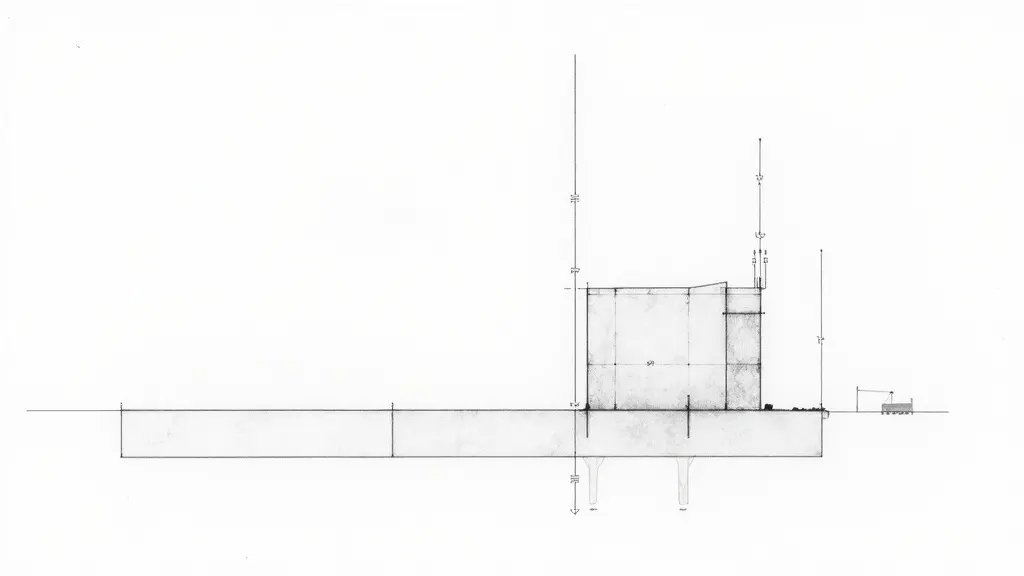
Constructed wall Neighbor’s land Your land Natural ground neighbor side Natural ground your side Hmeasured = 2.10 m Hactual = ? Ref. NGF-IGN69 Party boundary
The Calculation That Reveals the Actual Exceedance
The legal height of a party wall is governed by Article 658 of the French Civil Code. For a wall not attached to a building, the maximum height is often set by local custom or regulations. In Marseille, in urban areas, the common reference is 2.00 meters above the lowest point of the two adjacent grounds. The technical verification goes through this calculation: ΔH = |Hwall – Hlowest_ground| – Hmax_allowed. Let’s take a concrete Marseille case. Total station measurement from a georeferenced point RGF93/Lambert 93 (French geodetic system): ground elevation neighbor side = 87.42 m NGF, ground elevation your side = 87.94 m NGF. The lowest point is therefore at 87.42 m. Top of wall measured = 89.58 m NGF. Actual height Hactual = 89.58 – 87.42 = 2.16 m. With Hmax_allowed = 2.00 m, we get ΔH = 2.16 – 2.00 = +0.16 m. What this means concretely: the wall exceeds the limit by 16 cm. This is beyond tolerance. Article 662 of the Civil Code is clear: the neighbor can demand reduction to the legal height or a contribution to costs if the exceedance benefits him.
What Happens If You Do Nothing
Honestly, in six months, you’ll get used to it. But in two years, problems will appear. This raised wall alters rainwater runoff. With heavy Mediterranean rainfall in Marseille, water will flow differently, potentially creating infiltration zones on your facade. A simplified hydraulic calculation shows: the flow section is modified. In five years, structural disorders may occur if foundations were not designed for this extra height. Soil pressure σ = F/A increases. For a 20 cm thick concrete block wall, an extra 16 cm height represents about 120 kg per linear meter. If foundations were just at the limit, this can induce differential settlement.
Frequent secondary pathology in Marseille: cast shadow. A higher wall deprives your terrace of sunlight, impacting your quality of life and potentially your property value. Without action, you tacitly validate the situation. The cost of future compliance will be entirely yours if you delay too long.
Recourse and Guarantees: What You Can Demand
Article 657 of the Civil Code establishes the principle of party walls. Article 658 sets the heights. Your recourse is both technical and legal. First step: a registered letter with acknowledgment of receipt to the neighbor, contesting the height and requesting a joint expert appraisal. Mention Marseille and NGF-IGN69 references to be credible. If refused, file a petition with the Judicial Court of Marseille (tribunal judiciaire). What you can demand: either demolition of the excess upper part at the neighbor’s expense (Art. 662), or, if the wall is useful to you at that height, a contribution to half the construction costs and land occupied. Do not let a 16 cm exceedance become a multi-year neighbor dispute. A topographic survey with a total station, accurate to ±1 cm, will settle the debate in half a day.
Frequently Asked Questions
What is the legal height of a party wall in Marseille?
In urban areas of Marseille, the maximum height is typically 2.00 meters above the lowest adjacent ground, as per local custom and Article 658 of the Civil Code.
How is the actual height measured?
A topographic survey using a total station, referenced to the NGF-IGN69 vertical datum, provides an accurate measurement from the lowest natural ground point.
What can I do if the wall exceeds the legal height?
You can demand reduction to legal height at the neighbor’s expense (Art. 662) or, if beneficial to you, pay half the costs to keep it.
Articles connexes :
Absence de procès-verbal de réception VE…
📅 Mis à jour le 21/07/2026 — Par Cassini Expertise, expert bâtiment indépendant 06 & 83. Devis gratuit : 04 22 46 06 04.
Questions fréquentes
What is the legal height limit for a party wall in Marseille?
In Marseille, the height of a party wall is typically regulated by local urban planning rules (PLU) and the French Civil Code, but it often depends on the specific zone and the existing structures. If a neighbor builds unilaterally and exceeds the permitted height, they may be required to reduce it or pay damages. Always check the local mairie for exact limits.
Can my neighbor build higher than the party wall without my consent in France?
No, your neighbor cannot unilaterally raise a party wall without your agreement if it affects your rights, especially if it exceeds the local height regulations or causes a view obstruction. Under French law, they must obtain your consent or follow a legal procedure. If they build without consent, you can seek an injunction to have the excess removed.
What remedies do I have if my neighbor exceeded the party wall height in Marseille?
You can first send a formal notice to your neighbor to stop and remedy the situation. If they refuse, you can take legal action to obtain a court order for demolition of the excess or compensation for damages. It's advisable to consult a lawyer specializing in construction law and to contact the local urbanism department to verify the violation.